Justice K.S. Puttaswamy (Retd.) vs Union of India
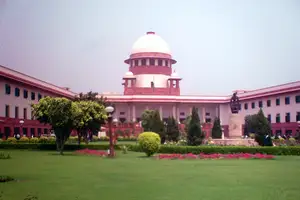
A nine-judge Bench of the Supreme Court of India held that the right to privacy is a fundamental right guaranteed under the Constitution of India.
Search the cases we're tracking — try a natural query like “murder cases in Maharashtra”.
72 cases · page 3 of 4
A nine-judge Bench of the Supreme Court of India held that the right to privacy is a fundamental right guaranteed under the Constitution of India.
On 15 February 2024, the Supreme Court of India unanimously declared the Electoral Bonds Scheme unconstitutional and manifestly arbitrary for violating the voter's right to information. Following this verdict, a plea was filed in the Supreme Court on 5 July 2024 seeking the confiscation of all electoral bond donations previously received by political parties.
The Supreme Court delivered a verdict regarding the constitutional powers of the Governor of Tamil Nadu concerning the assent of legislative bills. The ruling addressed the extent of the Governor's authority in withholding assent to bills passed by the state legislature.
In its 11 February 2021 judgment, the Supreme Court of India established significant principles regarding reasonable accommodation for persons with disabilities within the Union Public Service Commission civil services examination process. The precedent set by this decision continues to be cited by the Supreme Court in subsequent matters, as reported on 3 February 2025.
The Supreme Court examined whether private property can be considered a 'material resource of the community' under Article 39(b) of the Constitution. The Court held that not all private property falls under this definition, limiting the state's power to acquire private assets for public distribution.
The Supreme Court heard a petition challenging the inclusion of the words 'socialist' and 'secular' in the Preamble of the Constitution, which were added via the 42nd Amendment. The Court delivered its verdict on the matter.
A seven-judge Constitution Bench of the Supreme Court delivered a 4:3 majority verdict on 7 November 2024, overruling the 1967 S. Azeez Basha v. Union of India decision. The Court established new legal principles for determining the minority status of educational institutions and directed that the specific claim of Aligarh Muslim University be decided by a regular bench based on these criteria.
The Supreme Court of India adjudicated the ADM Jabalpur v. Shivakant Shukla case regarding the scope of Executive powers during a national Emergency. The Court's judgment addressed the suspension of fundamental rights and the application of the Rule of Law under the Constitution.
The State of West Bengal filed an original suit before the Supreme Court challenging the CBI's authority to register cases and conduct investigations within the state without the state government's consent. The Union of India has raised a preliminary objection, arguing that the suit is not maintainable and that the CBI operates independently of the Union government.
The State of Kerala challenged the Union of India's imposition of net borrowing ceilings on the state, citing constitutional provisions under Article 293.
A Public Interest Litigation was filed before the Supreme Court challenging the constitutional validity of the three new criminal law amendment acts that replace the Indian Penal Code, the Code of Criminal Procedure, and the Indian Evidence Act.
A Constitution Bench of the Supreme Court unanimously upheld the Union government's 2019 decision to abrogate Article 370, ruling that Jammu and Kashmir did not retain sovereignty upon acceding to India. In its judgment delivered on 11 December 2023, the Court also directed the Election Commission of India to hold elections in the region by 30 September of the following year.
A public interest litigation was filed in the Supreme Court seeking a direction that the new Parliament building be inaugurated by the President of India rather than the Prime Minister. The Supreme Court refused to entertain the petition.
The Supreme Court upheld the 2016 demonetisation of Rs 500 and Rs 1000 currency notes by a 4:1 majority. The court ruled that the decision-making process was not flawed or unlawful, while a dissenting opinion noted that the exercise was unlawful but could not be reversed.
The Supreme Court delivered a split verdict regarding the validity of a ban on wearing hijabs in educational institutions in Karnataka. The matter was referred to a larger bench due to the difference of opinion between the two judges.
The Supreme Court considered the implementation of reservations for Scheduled Castes and Scheduled Tribes in government job promotions. On 28 January 2022, the Supreme Court delivered a final judgment providing directions on the application of these quotas in government services.
A landmark Supreme Court case that challenged the constitutionality of Section 66A of the Information Technology Act, which criminalized sending offensive messages online.
The Supreme Court examined the constitutional validity of the Maharashtra State Reservation for Socially and Educationally Backward Classes (SEBC) Act, 2018, which provided reservation to the Maratha community. The court declared the law unconstitutional, citing the lack of exceptional circumstances to exceed the 50% reservation ceiling established in the 1992 Indra Sawhney judgment.
The Supreme Court delivered a verdict regarding petitions challenging the indefinite public protests at Shaheen Bagh, Delhi, which were held against the Citizenship Amendment Act. The court examined the balance between the right to protest and the right of the public to access common areas.
In this litigation, the Supreme Court of India declared Section 377 of the Indian Penal Code unconstitutional to the extent that it criminalized private consensual sexual acts between adults. The five-judge Constitution Bench ruled on 6 September 2018 that the provision was irrational and arbitrary. As of 15 November 2018, the central government had yet to implement the court's directive to conduct public sensitization programs regarding the decriminalization.
Looking for a specific case? Describe the event and we'll verify it against trusted sources.